
Coin Lockers in Japan: Prices, Sizes, Suica Payment & What to Do When Full
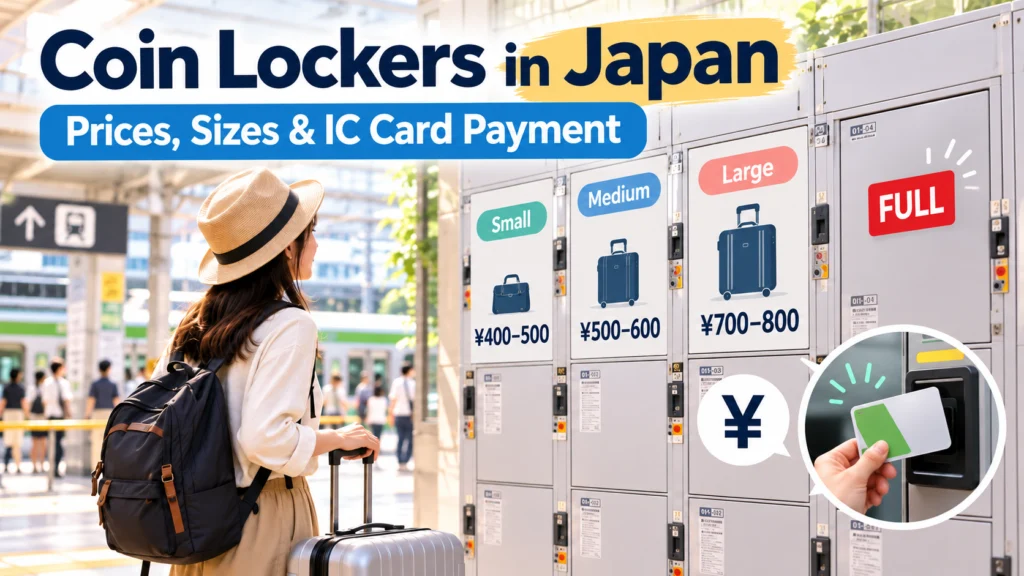
Quick answer: Japan's station lockers can save a travel day, especially if you arrive long before hotel check-in. But the locker bank you find may be full, too small for a suitcase, or inaccessible after the station closes. Here's how to choose a realistic plan.
Where to find a station coin locker
Look inside major railway stations near ticket gates, concourses, underground passages and shopping entrances. Many large stations have lockers on both the paid and unpaid sides of the gates. If your bag needs collecting after sightseeing, the distinction matters: you may otherwise have to pass the ticket gates again. Photograph the locker number, exit, floor and nearby signs before walking away.
A smaller station is not necessarily a better choice: it may have fewer large compartments or limited access after hours. If you are transferring to another city, compare local storage with hotel-to-hotel luggage forwarding.
What do small, medium and large lockers cost?
Tokyo's official tourism guide gives these illustrative price ranges: small about ¥400–500, medium about ¥500–600, large about ¥700–800, and extra-large about ¥1,200. They are not guaranteed rates across Japan; an individual locker bank may charge differently. Look at the sign or machine display before committing.
Dimensions are not standardized across every operator. A suitcase that fits in one station's “large” compartment might not fit another. Measure your bag's length, width and depth rather than relying on the label.
How to pay with cash, Suica or PASMO
Traditional lockers may use a mechanical key and coins. GO TOKYO advises carrying some ¥100 and ¥500 coins because some machines accept only these coins. At electronic locker banks, choose an available compartment on the touchscreen and follow the prompts.
If an IC-card symbol appears, a Suica or PASMO may be accepted. Tap the card as directed; at many electronic lockers the same card is used to unlock the compartment later. Keep it with you. If you used a phone, maintain enough battery to retrieve the luggage. A touchscreen machine is not proof that every international payment card works.
How long can luggage stay in a locker?
Do not assume the quoted locker price covers a full rolling 24-hour period. Charging cutoffs and maximum storage durations are set by the operator. Some banks count a new usage day after an overnight cutoff. Also, a locker inside a building may not be accessible after the building closes even if the station itself still has train services.
Before leaving luggage overnight, read the posted rules for extra charges, maximum days and procedures for unclaimed property. If the information is not clear, ask station staff or choose staffed storage.
If every large locker is full
Try another locker bank at the same station, including a different exit or level. If you are carrying a large suitcase and must return by a fixed time, use a staffed baggage counter or other verified storage service with confirmed opening hours. Hotel reception may hold a bag for a guest, but ask rather than assuming this service is included. For intercity travel, shipping to your next hotel may be more useful.
A simple decision guide
- Two hours of shopping near the station: a locker is usually convenient.
- Exploring a city until late at night: confirm when the locker becomes inaccessible.
- Large suitcase, busy holiday: plan an alternative before arriving.
- Changing cities: compare locker fees with forwarding and the delivery time.
Do not store passports, essential medicines, valuables or the only copy of your travel documents in an unattended compartment. Keep an emergency option in case the lock malfunctions or a transport delay changes your pickup time.
Related travel guides
Official sources and fact-checking
Checked against published official information on October 25, 2026. Check original operators for changed prices, opening times, seasonal schedules and access rules before traveling.